
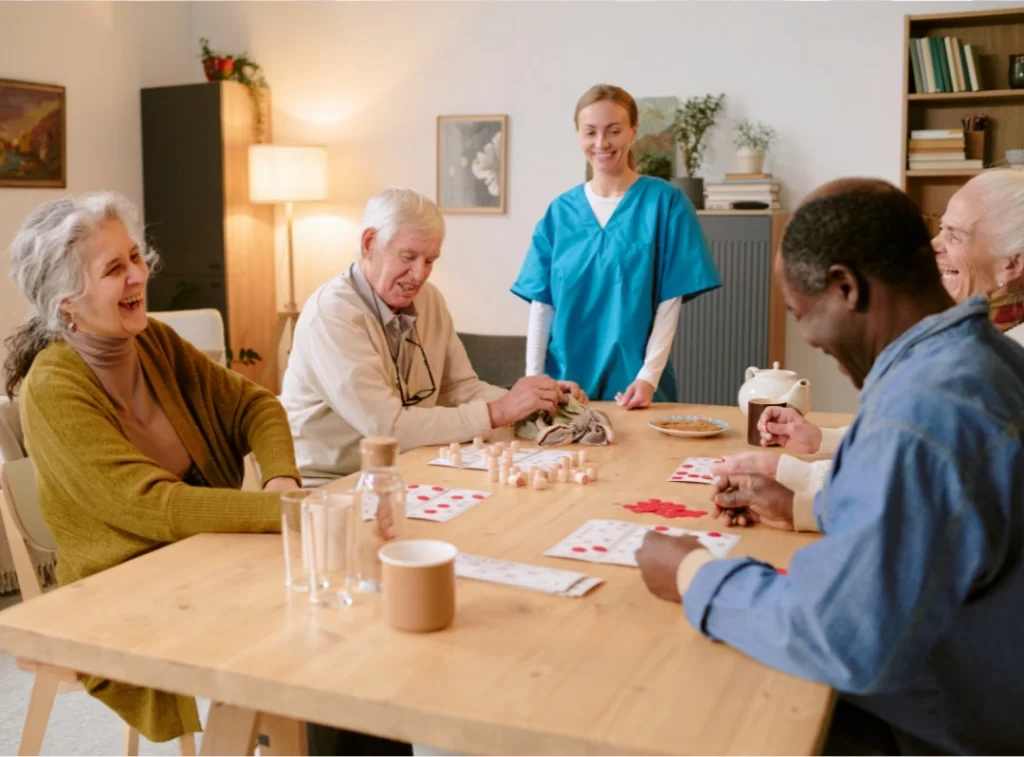
When people hear the word Montessori, they often think of early childhood education. Yet the Montessori philosophy was never intended to be limited to children. At its core, Montessori is about respect for the person, meaningful engagement, and enabling independence — principles that are deeply relevant in dementia care.
In recent decades, the Montessori approach has been thoughtfully adapted for people living with dementia, offering a strength-based, rehabilitative framework that focuses not on loss, but on what remains.
Where Montessori began — and why it matters in dementia
The Montessori philosophy originated with Maria Montessori, Italy’s first female medical doctor. In the early 1900s, Dr Montessori worked with children who were considered “unteachable,” many with intellectual and developmental disabilities. Rather than focusing on deficits, she redesigned environments and activities to support participation, autonomy, and learning.
Her guiding belief was simple but radical:
“Everything you do for me, you take from me.”
This philosophy – that independence, not over-assistance, preserves dignity – underpins modern Montessori-based dementia care.
How Montessori entered the dementia space
The application of Montessori to dementia is largely credited to Cameron Camp, an American psychologist specialising in ageing and dementia care. Dr Camp recognised that Montessori classrooms were designed to circumvent cognitive and physical challenges, not confront them, making the approach highly transferable to dementia.
Dr Camp famously described people with dementia as:
“Normal people who happen to have a memory deficit.”
Montessori-based dementia care builds environments, activities, and roles that reduce reliance on impaired systems while maximising preserved abilities.
The science behind Montessori: procedural memory
One of the most powerful aspects of Montessori in dementia care is its grounding in neuropsychology.
Dementia commonly affects declarative memory: facts, dates, personal history, and orientation. In contrast, procedural memory (sometimes called muscle memory) – the memory for skills and routines – is often preserved well into the disease progression.
Procedural memory supports activities such as:
-
eating with utensils
-
folding laundry
-
gardening
-
using tools
-
singing familiar songs
Montessori-based activities are deliberately designed to activate procedural memory, allowing people to participate successfully even when language, insight, or recall are impaired.
This distinction is crucial and highly relevant to Speech Pathology, Occupational Therapy, and Physiotherapy practice.
Montessori and communication: implications for Speech Pathology
Communication is central to identity, autonomy, and wellbeing. As dementia progresses, people may experience:
-
reduced expressive and receptive language
-
word-finding difficulty
-
reduced initiation
-
changes in attention and processing speed
-
reversion to a first language in bilingual speakers
The Montessori approach aligns strongly with functional communication principles, including:
-
talk less, demonstrate more
-
using visual cues and environmental prompts
-
breaking tasks into meaningful, observable steps
-
supporting choice-making without relying on complex verbal reasoning
For Speech Pathologists, Montessori principles map closely onto:
-
communication partner training
-
aphasia-friendly environments
-
functional swallowing and mealtime participation
-
error-free learning
-
cueing hierarchies and task scaffolding
Montessori reframes communication support as participation-focused, not performance-based.
Purposeful activity is not “busy work”
A core Montessori principle is that every activity has a purpose. Activities are not used to occupy time, but to support:
-
independence
-
motor function
-
attention and engagement
-
self-esteem
-
contribution to the community
Examples include:
-
using tongs to serve food (supporting grip and self-feeding)
-
hanging out laundry (upper limb strength, sequencing)
-
gardening (gross motor skills, sensory input)
-
setting tables or sorting items (executive function and role identity)
From a rehabilitation perspective, these are embedded therapeutic tasks, not distractions.
The environment as a therapeutic tool
Montessori places strong emphasis on the prepared environment. For people living with dementia, this may include:
-
clear signage and labels
-
calendars with day and date visible
-
consistent routines
-
reduced clutter
-
strong colour contrast
-
meaningful objects placed in visible locations
These environmental “cognitive ramps” reduce the cognitive load required to function, enabling greater independence with less verbal prompting.
This approach is especially powerful when integrated with Speech Pathology-led strategies for:
-
wayfinding
-
mealtime safety
-
communication access
-
reduced frustration and behavioural distress
The 12 principles of engagement
Montessori-based dementia care commonly applies 12 principles of engagement, including:
-
inviting rather than instructing
-
demonstrating rather than explaining
-
matching pace to the person
-
progressing from simple to complex
-
focusing on success, not correctness
-
ending with reflective feedback (“Did you enjoy this?”)
These principles reinforce error-free, dignity-preserving engagement – a critical shift away from task completion toward relational connection.
Montessori across all stages of dementia
Importantly, Montessori is not stage-limited. Because it relies on procedural memory, sensory engagement, and environmental support, it can be adapted across:
-
early dementia
-
moderate dementia
-
advanced dementia
In later stages, sensory-based Montessori activities (touch, music, scent, rhythm) remain powerful tools for engagement and emotional regulation.
Why this matters
Montessori reframes dementia care from doing for to enabling with. It shifts the narrative from decline to retained capacity, and from risk-avoidance to meaningful participation.
For families, carers, and clinicians alike, it offers a practical, evidence-informed framework for preserving dignity – even as cognition changes.
Further learning and resources
-
Dementia Australia
Montessori approach to activities webinar (Centre for Dementia Learning)
https://www.dementia.org.au -
Montessori Australia – Ageing & dementia
https://montessori.org.au/montessori-ageing-dementia -
Association Montessori Internationale – Dementia, disability & ageing
https://montessori-ami.org/about-montessori/montessori-dementia-disability-ageing -
Camp, C. (2013). Relate, Motivate, Appreciate: An Introduction to Montessori-Based Dementia Care
References
Camp, C. J. (2010). Montessori-based activities for persons with dementia. American Journal of Alzheimer’s Disease & Other Dementias, 25(3), 203–212.
Camp, C. J., Judge, K. S., Bye, C. A., Fox, K. M., Bowden, J., Bell, M., & Mattern, J. M. (1997). An intergenerational program for persons with dementia using Montessori methods. The Gerontologist, 37(5), 688–692.
Dementia Australia. (2023). Montessori approach to activities [Webinar]. Centre for Dementia Learning.
Montessori, M. (1967). The absorbent mind. Holt, Rinehart & Winston.
van der Ploeg, E. S., Eppingstall, B., & O’Connor, D. W. (2013). The study protocol of a cluster-randomised controlled trial of family-mediated personalised activities for nursing home residents with dementia. BMC Geriatrics, 13, 52.