
When we assess swallowing, we are accustomed to measuring what happens during a swallow. We examine airway protection, timing, bolus clearance, pharyngeal residue, hyolaryngeal excursion, upper oesophageal sphincter opening and, increasingly, measures of swallowing strength and muscle morphology.
But there is another variable that receives considerably less attention in routine clinical practice: how often is the person swallowing in the first place?
Swallowing is not confined to eating and drinking. Throughout the day, spontaneous swallowing occurs repeatedly to manage saliva and other oropharyngeal secretions. These swallows represent ongoing activation of the muscles involved in swallowing — activity that continues between meals and independently of any prescribed rehabilitation program.
This isn’t a new area of investigation. Swallowing frequency has been studied for decades, with researchers examining its relationship with ageing, neurological disease, functional status, secretion management and dysphagia. Two recent studies add an interesting new piece to this literature: daily swallowing frequency appears to be associated with the mass of at least one swallowing-related muscle.
The geniohyoid is one of the suprahyoid muscles contributing to anterior and superior displacement of the hyoid during swallowing. This movement contributes to hyolaryngeal excursion and upper oesophageal sphincter opening and forms an important component of efficient bolus clearance and airway protection. Importantly for research and increasingly for clinical practice, the geniohyoid can be visualised non-invasively with ultrasound, allowing its cross-sectional area to be measured as an estimate of muscle mass.
Uota and colleagues recently investigated the relationship between swallowing frequency and geniohyoid muscle mass in 62 adults with severe motor and intellectual disability (SMID), with a mean age of 46.9 years. Daily swallowing frequency was measured using a laryngeal microphone, while geniohyoid cross-sectional area was measured using ultrasound. Greater swallowing frequency was associated with greater geniohyoid cross-sectional area, and swallowing frequency, body weight and sex were independently associated with muscle size.
Read the Uota et al. study in Brain and Development
The finding is particularly interesting in a population in whom swallowing activity may be affected by substantial motor impairment, dysphagia, feeding method and dependence for everyday activities. However, a second recent study suggests that this relationship is not confined to people with SMID.
Kawamichi and colleagues examined 84 older adults living in long-term care or elderly care facilities. Again, swallowing frequency was determined from laryngeal sounds and geniohyoid cross-sectional area was measured with ultrasound. Swallowing frequency and geniohyoid muscle mass were positively correlated (r = 0.437), and when other variables were considered, sex, whole-body muscle mass and swallowing frequency remained independently associated with geniohyoid muscle mass.
Read the Kawamichi et al. study in Journal of Oral Rehabilitation
Taken together, these findings raise an interesting possibility: swallowing-related muscle mass may reflect not only overall body composition, but also local activity of the swallowing system.
This work sits within a much longer research story. In 2013, Tanaka and colleagues measured spontaneous swallowing during daily life in older and younger adults. Older participants swallowed an average of 9.4 times per hour, compared with 40.7 times per hour in healthy younger adults. Swallowing frequency was also lower among bedridden older adults than those who were semi-bedridden.
Perhaps equally important was the degree of individual variation. The older adults ranged from 2–19 swallows per hour, while younger adults ranged from 16–76.
Read Tanaka et al.’s study of swallowing frequency during daily life
This variability matters. Swallowing frequency is influenced by much more than a person’s ability to execute a swallow. Salivary production, sensory input, age, activity, neurological function, medications, alertness and oral intake may all influence how frequently spontaneous swallowing occurs. Measurement conditions matter too: a brief recording at rest is not equivalent to monitoring someone for hours during their usual daily activities, and saliva swallowing between meals is not the same measure as the number of swallows occurring during food or fluid intake.
So the clinically useful question may not be “How many times should everybody swallow per hour?” It may be “How much swallowing activity is this person actually getting across their day, and has that changed?”
The concept is familiar elsewhere in rehabilitation. We distinguish between exercise and activity. Someone may complete a prescribed lower-limb strengthening program, but their total physical activity across the remainder of the day also matters. A short exercise session does not necessarily tell us how much that muscle system is being used during everyday life.
Swallowing may deserve similar consideration. In dysphagia rehabilitation, we often think carefully about exercise dose: repetitions, resistance, intensity, frequency and progression. Yet a person who previously ate three meals, drank throughout the day and regularly swallowed saliva may experience a dramatic change in overall swallowing activity during illness or following a change in feeding status.
This may be relevant to people with nil or minimal oral intake, enteral feeding, prolonged hospitalisation or critical illness, significant frailty or immobility, reduced alertness, xerostomia or altered salivary function, and severe neurological or motor impairment. Indeed, the development of ambulatory swallowing-frequency measures was partly driven by concern that marked reductions in swallowing activity in people with poor oral intake could contribute to disuse of swallowing-related structures.
Importantly, the current studies do not demonstrate that reduced swallowing frequency causes swallowing muscle atrophy in these populations. Both recent muscle-mass studies were cross-sectional. People with greater muscle mass might swallow more frequently; greater swallowing activity might contribute to maintaining muscle; or both may reflect other physiological and functional factors. Nor do these studies demonstrate that asking someone to perform additional saliva swallows will increase muscle mass or improve swallowing function.
What they do suggest is that the amount of swallowing occurring outside our rehabilitation sessions may be worth paying considerably more attention to.
This is where the research becomes particularly interesting. Unlike VFSS or FEES, which provide detailed information about sampled swallowing events, measuring frequency requires a way of detecting swallows repeatedly — potentially over hours of ordinary life.
One of the most established approaches is laryngeal microphone or acoustic swallow detection. A small external microphone positioned over the neck captures the acoustic events associated with swallowing, which can then be analysed to identify individual swallows. Tanaka and colleagues developed a swallowing-frequency meter using a laryngeal microphone specifically to allow monitoring without substantially restricting normal daily activity, and variations of this approach have subsequently been used in studies of spontaneous swallowing frequency and muscle mass.
See the development and validation of the laryngeal microphone swallowing-frequency meter
Acoustic recording can also be used without the complete ambulatory system. Crary, Sura and Carnaby evaluated an acoustic technique for estimating spontaneous swallowing frequency, initially validating swallow identification using a multichannel physiological system incorporating surface electromyography, respiratory information and cervical auscultation. The validated multichannel method achieved high sensitivity and specificity for identifying swallow events, supporting subsequent comparison with isolated acoustic recording.
Read Crary et al. on acoustic measurement of spontaneous swallowing frequency
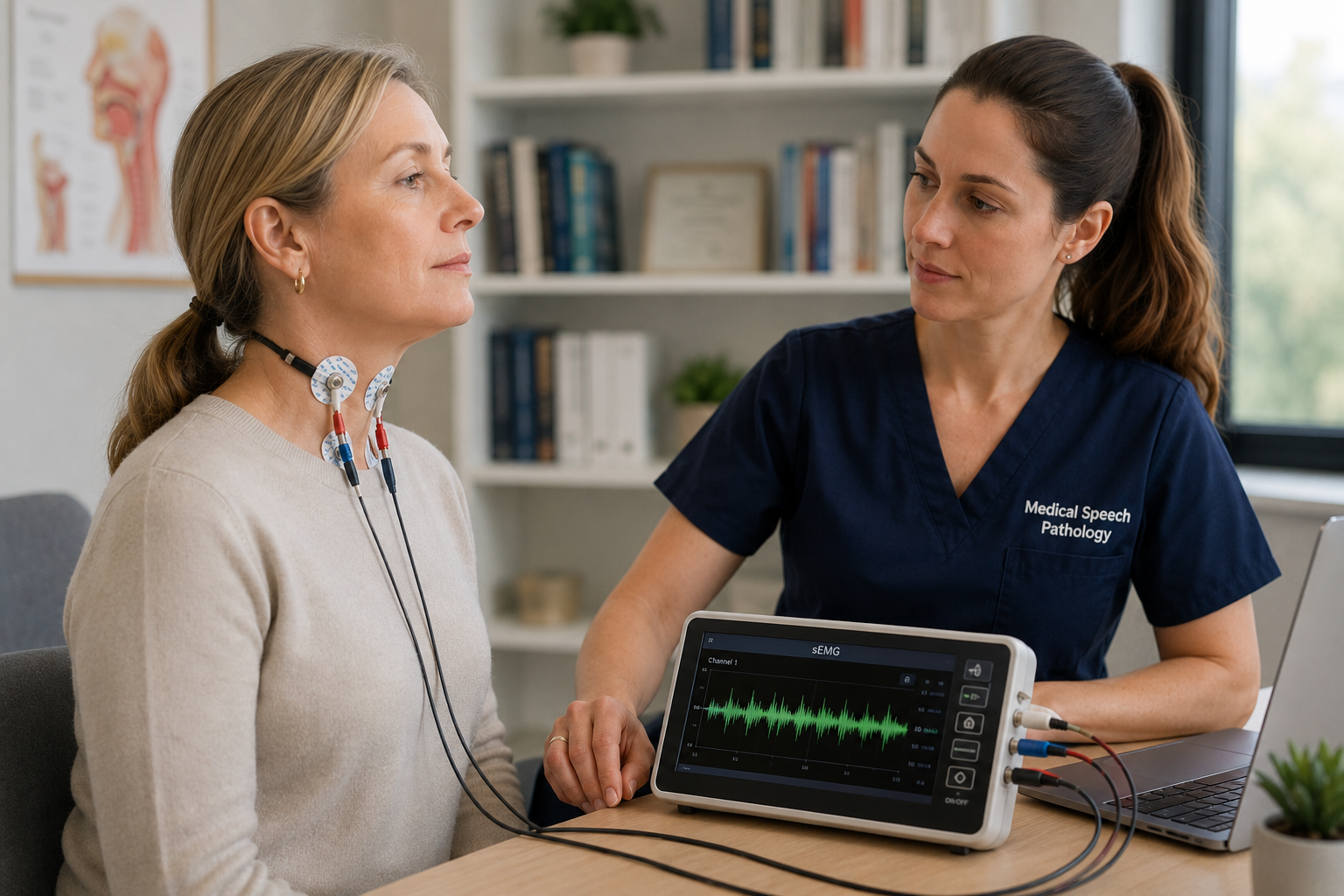
Other approaches use surface electromyography (sEMG) to detect activation of the suprahyoid musculature, cervical accelerometry to detect mechanical movement associated with swallowing, or combinations of physiological signals. Multimodal approaches are attractive because no single external signal is perfectly specific to swallowing: speech, coughing, throat clearing and head or neck movement can all generate acoustic, muscular or mechanical events. Combining signals can improve confidence that an identified event really was a swallow.
At the simplest end of the spectrum, however, swallowing frequency can also be observed clinically. A clinician can count visible or palpable hyolaryngeal movements during a defined period of quiet rest, producing a measure such as spontaneous swallows per five or ten minutes. This clearly lacks the sensitivity and ecological validity of prolonged ambulatory monitoring — subtle swallows may be missed, awareness of observation may change behaviour, and ten minutes in a clinic may bear little resemblance to the rest of someone’s day. It may nevertheless have value as a descriptive within-person observation when conditions are reasonably standardised and the limitations are recognised.
There is also an existing bedside measure that becomes particularly interesting in this context: the Repetitive Saliva Swallowing Test (RSST). The RSST asks the person to swallow their saliva as many times as possible over 30 seconds while the examiner counts swallows, traditionally by palpating laryngeal elevation. The original validation work compared the RSST with videofluorography and proposed two or fewer swallows in 30 seconds — equivalently, fewer than three — as a screening threshold warranting further investigation.
Read the original RSST validation study by Oguchi et al.
Later work has examined RSST performance in healthy adults across different age groups and in people following stroke, demonstrating that RSST scores vary with age and sex and that its diagnostic performance depends on the population and comparator used. It is therefore better understood as one component of swallowing assessment rather than a universal stand-alone test for dysphagia.
Read more about RSST norms, clinical relevance and saliva secretion
There is also an important conceptual distinction between the RSST and the swallowing-frequency research discussed above. The RSST measures elicited swallowing capacity; spontaneous swallowing frequency measures habitual swallowing activity. During an RSST, we explicitly ask the person to swallow repeatedly. Their result may reflect their ability to initiate repeated swallows, motor capacity, cognition and ability to perform the task, among other factors. A spontaneous swallowing measure asks something different: when nobody is telling this person to swallow, how often does it happen?
That difference could potentially be clinically informative. Someone may be capable of producing several saliva swallows within 30 seconds when prompted but spontaneously swallow very infrequently during daily life. Conversely, poor performance during repeated volitional swallowing does not necessarily tell us how many spontaneous swallows occur across the person’s day.
For now, a clinician interested in this area could therefore document an RSST alongside a standardised period of spontaneous swallow observation, while recognising that the latter is descriptive rather than a validated clinical outcome unless a published protocol is being followed. Longitudinally, the two measures potentially capture different aspects of the same system: what the person can produce when asked and how frequently that system is actually activated when they are not being asked.
This distinction becomes particularly important if swallowing frequency is to develop into a meaningful clinical measure. A ten-minute recording in a quiet clinic answers a different question from an eight-hour ambulatory recording during ordinary activity. Likewise, swallowing frequency during meals is not equivalent to spontaneous saliva swallowing between meals.
Research protocols differ in whether participants are awake or asleep, eating or fasting, resting or moving, and aware or unaware that swallowing is being monitored. Even the denominator matters: swallows per minute during a brief recording and swallows per hour across waking daily life are not necessarily interchangeable.
This also makes comparison against a single normative value problematic. The Tanaka study, for example, found enormous variation even within its healthy younger group. For clinical purposes, change within an individual may eventually prove more informative than comparison with a universal target.
Imagine a person who moves from regular oral intake to enteral feeding during an acute illness. Or someone whose oral intake gradually reduces alongside increasing frailty. Rather than simply knowing that their swallowing frequency is “low”, longitudinal measurement could potentially tell us whether their own habitual swallowing activity has changed substantially from baseline and, eventually, whether that change has physiological consequences.
Potentially. What makes swallowing frequency appealing is that it captures something many of our existing measures do not.
FEES and VFSS provide extraordinarily valuable information about swallowing physiology and function during sampled swallowing events. Strength measures tell us something about physiological capacity. Ultrasound can provide information about muscle morphology. sEMG can quantify aspects of muscle activation during exercise. The RSST can tell us something about a person’s ability to generate repeated saliva swallows when prompted.
But spontaneous swallowing frequency asks a different question: how much is this system actually being used in everyday life?
That could make it particularly interesting as a longitudinal measure if wearable technologies eventually allow reliable, unobtrusive monitoring across hours or days. The analogy with step counting is useful here. A physiotherapist may assess someone’s strength and gait in the clinic, but a wearable step count answers a different question about how much walking actually occurs in everyday life. A future swallowing monitor could potentially complement — rather than replace — our existing physiological and functional assessments in much the same way.
This remains a research direction rather than established clinical practice. There is not currently an evidence-based daily “swallow target”, and these studies should certainly not lead us to prescribe arbitrary numbers of additional saliva swallows.
They should, however, broaden how we think about dose. A rehabilitation program might prescribe 30, 50 or 100 targeted repetitions, and that dose matters. But the swallowing system is also being used — or not used — throughout the remainder of the day. For someone whose oral intake and spontaneous swallowing activity have substantially decreased, prescribed exercise and total daily swallowing activity are related but distinct concepts.
The next questions are therefore more interesting than simply asking whether swallowing frequency correlates with muscle mass. Does a reduction in daily swallowing activity predict subsequent change in swallowing muscle morphology or function? Does maintaining swallowing activity during periods of reduced oral intake protect against disuse? Can habitual swallowing frequency be modified? Do changes in frequency during rehabilitation correlate with functional recovery?
And could wearable swallow monitoring eventually give clinicians something analogous to a step count for swallowing — not as a replacement for instrumental assessment, but as a measure of what the swallowing system is doing during the many hours when we aren’t observing it?
The recent studies don’t answer those questions. But they give us another reason to start asking about (and measuring) them.
Uota C, Nohara K, Tanaka N, Fujii N, et al. Effect of daily swallowing frequency on swallowing-related muscle mass in individuals with severe motor and intellectual disability. Brain and Development. 2026;48(4):104553. Article
Kawamichi H, Obana A, Nohara K, Tanaka N, Sakai T. Relationship Between Swallowing Frequency and Swallowing-Related Muscle Mass in Older Adults. Journal of Oral Rehabilitation. 2026;53:42–49. Open-access article
Tanaka N, Nohara K, Kotani Y, Matsumura M, Sakai T. Swallowing frequency in elderly people during daily life. Journal of Oral Rehabilitation. 2013;40:744–750. PubMed record
Tanaka N, Nohara K, Kotani Y, et al. Development of Swallowing Frequency Meter Using Laryngeal Microphone. Japanese Journal of Dysphagia Rehabilitation. 2010;14(3):229–237. Free full-text article and PDF
Crary MA, Sura L, Carnaby G. Validation and demonstration of an isolated acoustic recording technique to estimate spontaneous swallow frequency. Dysphagia. 2013;28:86–94. Article record and abstract
Oguchi K, Saitoh E, Mizuno M, et al. The Repetitive Saliva Swallowing Test (RSST) as a Screening Test of Functional Dysphagia. 2000;37(6):383–388. Free article and PDF via J-STAGE
Persson E, Wårdh I, Östberg P. Repetitive Saliva Swallowing Test: Norms, Clinical Relevance and the Impact of Saliva Secretion. Dysphagia. 2019;34:271–278. Free full-text article
Share: